

Every customer email answered, from your own rules.
Your office reads the mail that comes to your business, answers the questions your rules cover, and asks you about the rest. When you answer once, it can remember the answer for next time.
Updated 15 October 2026
How it works.
- Connect your mailbox
Gmail, or any mailbox with IMAP: IONOS, Strato, GMX, Zoho, iCloud, your host's mail. Up to five, such as info@ and sales@. Mail that came before you connected is left alone.
- Give it your facts
It reads your website once and turns it into rules, or starts from a template for your kind of business. Nothing it read answers anyone until you have checked it and switched it on.
- It answers what it knows
Prices, hours, how booking works, what you deliver and when: answered from your rules, in the customer's own language, any hour of the day.
- It asks you the rest
A question your rules do not cover comes to you on Telegram, in the app or in the panel. Your answer goes to the customer as a proper reply, and one tap keeps it as a rule.
Only your customers get an answer.
A business inbox is mostly not customers. Before anything is written, your office decides who sent the mail. Newsletters, promotions, notifications and scams are left alone. A job application, a threat or a lead it cannot place is not answered either, but you are told about it.
A sender the receiving mail server could not verify is never answered, so a forged message cannot make your office reply to a stranger or cancel someone's appointment.
Your own people are not customers. Mail from your accountant, your staff or the addresses you name is kept out of the customer loop. Supplier invoices go to your books instead, read and counted.
Left alone, never answered
- Newsletters, promotions and notifications
- Spam and scams
- Mail from senders the server could not verify
- Your own people: your accountant, your staff, anyone you name
- Mail that arrived before you connected
Checked before it is sent.
Every answer is written from your rules and then checked, statement by statement, against them. An answer that says something your rules do not is not sent; the question comes to you instead. A phone number, a price or a promise that is not in your rules is not made up.
A complaint, a refund question or an angry customer gets the most care, because a mistake there costs you the most.
The reply always goes to the customer who wrote. An instruction hidden inside an email, such as "send this to another address", cannot change where a reply goes: that is checked by code against the conversation on record, not left to the AI.
One answer, not two.
When your office does not know something, it does not send "we will get back to you" and then a second email. It asks you, and the customer's first reply is the real answer, written from what you said. If you take long, one short note goes out so the customer is not left wondering.
Your answer is rewritten as a proper reply, not forwarded. A separate check makes sure the reply adds nothing you did not say. Your note to the office stays between you and it.
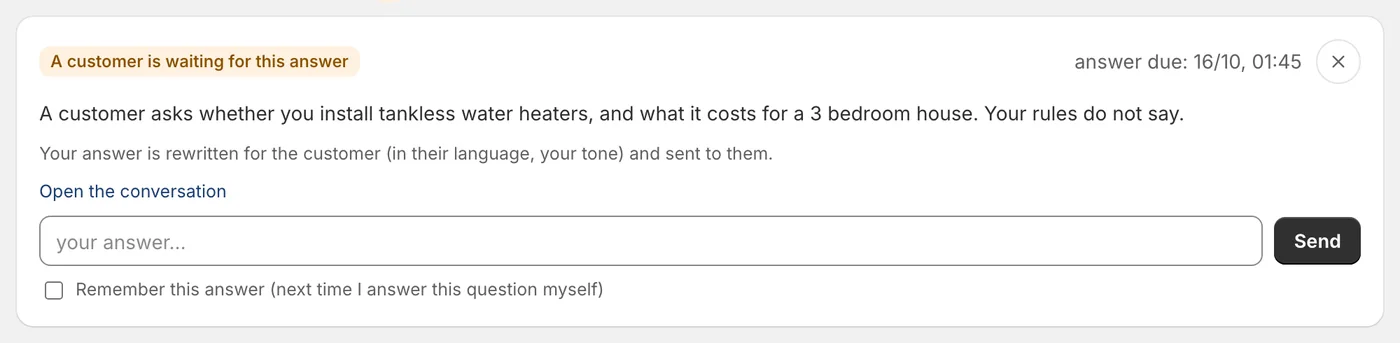
"Do you deliver to Rotterdam on Saturdays?"An example. A customer's question your rules do not cover goes to you, on Telegram, with the customer's own words. You answer "Yes, until 2 pm, 5 euros extra", and that is what the customer reads, as a proper reply. One tap keeps it as a rule for the next customer who asks.
You stay in charge of every conversation.
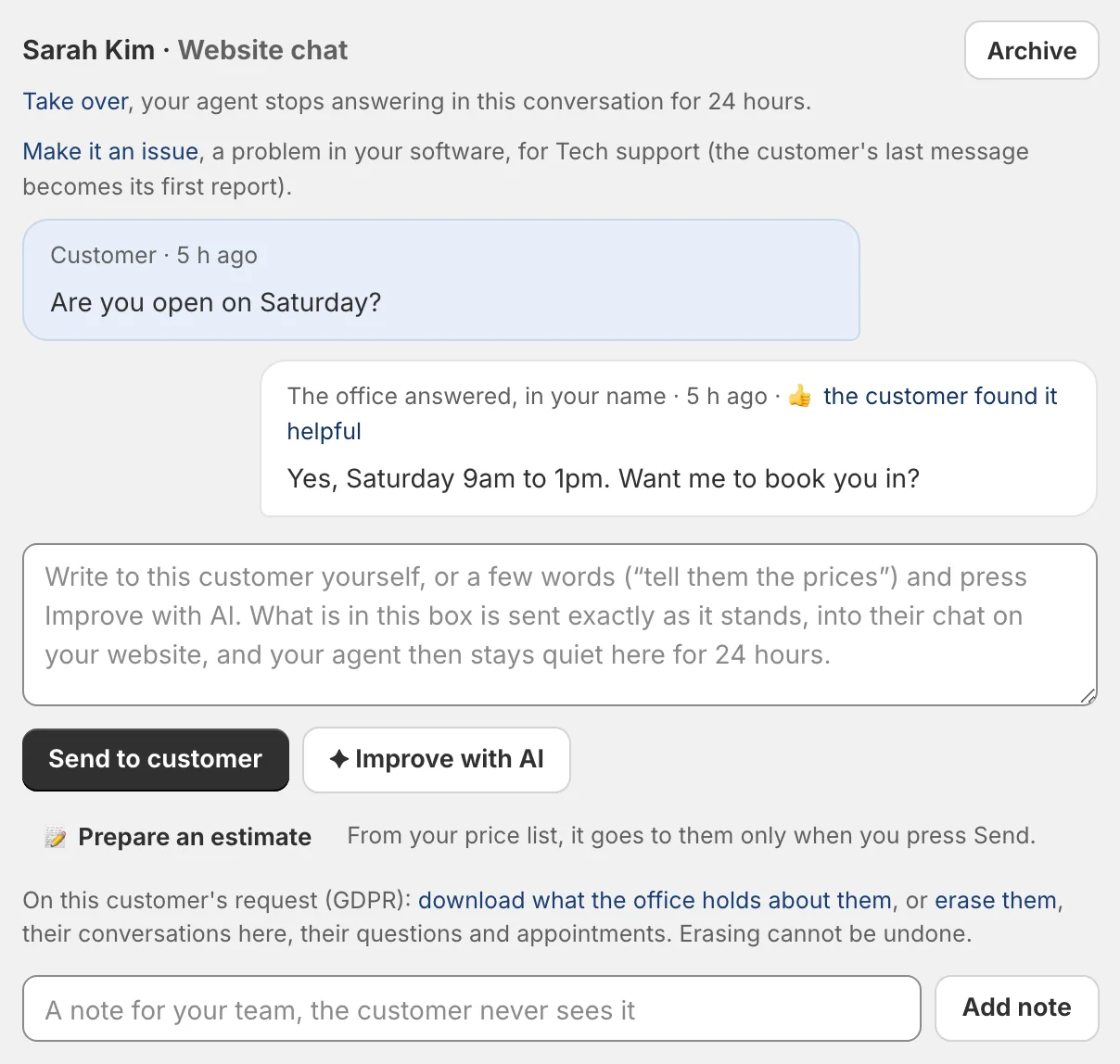
- Answer it yourself. Reply from the Inbox and your office stays out of that conversation for a day. "Improve with AI" can tidy your words first; nothing is sent until you press Send.
- See why it answered. Under every answer the Inbox shows the rules it came from, so a wrong answer is fixed in the rule, not patched case by case.
- Hear from customers. Every answer can be rated by the customer. A thumbs down asks you what the answer should have been.
- It says it is AI. Every automated email carries one short line saying it was written with AI, in the customer's language, as the EU AI Act asks. A reply you write or approve yourself is yours.
What it does not do.
It is a front desk for your customers, not a mass mailer and not a guesser. It also answers your website chat and Telegram the same way; WhatsApp, Instagram and Messenger are coming. Outlook mailboxes are coming too.
The service is hosted in the EU. To write an answer, the customer's message is read by the AI providers named on our sub-processors page, under a data processing agreement.
It never
- Invents a fact that is not in your rules
- Sends marketing to people who did not agree to it
- Answers mail that is not from a customer
- Writes to anyone other than the person who wrote
Asked before you start.
Which mailboxes does it work with?
Gmail, and any mailbox that speaks IMAP and SMTP: IONOS, Strato, GMX, Zoho, iCloud, your hosting company's mail and more. You can connect up to five mailboxes, such as info@ and sales@. Outlook is coming.
Will it answer newsletters, invoices or spam?
No. Only mail from a customer is answered. Promotions, notifications, job applications and scams are left alone, and mail whose sender the receiving server could not verify is never answered.
What happens when it does not know the answer?
It does not guess. It asks you on Telegram, in the app or in the panel, and sends your answer to the customer in a proper reply. One tap turns your answer into a rule for next time.
Does the customer know an AI wrote the reply?
Yes. Every automated email carries one short line saying it was written with AI, as the EU AI Act asks. A reply you write or approve yourself is yours and carries no such line.
Can I write a reply myself?
Yes. Answer from the Inbox and the office stays out of that conversation for a day. "Improve with AI" can tidy your words first; nothing is sent until you press Send.
Read next
Set up your office in an afternoon.
Free to set up, no card needed. It reads your website, asks what it could not find, and nothing goes live until you have checked it.