

How to choose an AI assistant for your small business.
An assistant that answers your customers speaks for your business when you are not looking. Ask these ten questions first, of any assistant, including ours.
Updated 15 October 2026
Before you let an AI work for your business.
An AI assistant that only helps you write is a tool. One that answers your customers, books their appointments or posts in your name is closer to a new employee: it speaks for your business when you are not looking. The questions below are the ones worth asking before you give any of them that job. They come from building one, and from the mistakes we had to design out.
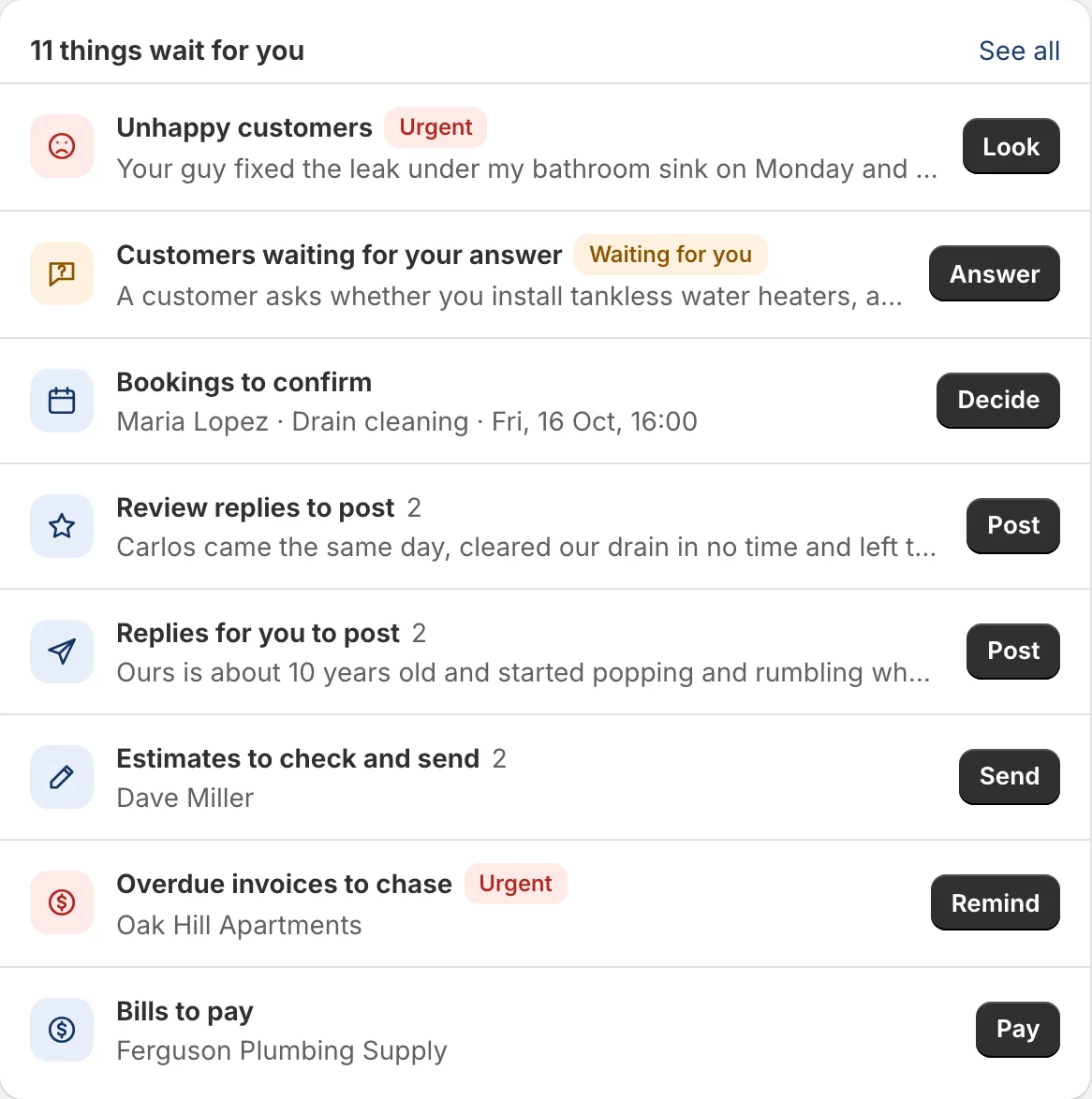
One habit matters more than any feature: an assistant should bring you only what needs you, in one place, and handle the rest. Here is what that looks like in our own product, so you can compare it with whatever you try.
Ten questions, and what a good answer sounds like.
1. Does it answer customers, or only draft for you?
Both are useful, but they are different jobs. A drafting assistant saves you typing; you still answer every message. An assistant that answers on its own saves the hours, and then everything below matters more.
2. Where do its facts come from?
Good answer: from what you gave it (your website, your price list, your own words), and it can show you which rule an answer came from. Be careful with any assistant that fills gaps with what "sounds right": a wrong price or opening time is worse than no answer.
3. What does it do when it does not know?
Good answer: it asks you, and tells the customer only what is true ("I am checking this for you"). It should never guess, and your answer should reach the customer without you having to write the whole reply again.
4. What can it do without your OK?
Look for a clear line between what it does by itself and what waits for you: sending, posting in public, booking, spending money. You should be able to start strict and loosen it as you trust it, one kind of action at a time.
5. Is it available where your business is, and where is the data?
Some assistants work only in some countries. In the EU, ask where it is hosted, which companies read your customers' messages (its sub-processors), and for a data processing agreement, which the GDPR requires when it handles personal data for you (Art. 28).
6. Does it tell people they are talking to AI?
The EU AI Act requires that people are told when they interact with an AI system, unless it is obvious, and some US states, such as California and Utah, have laws on bots saying that they are bots. A good assistant says it in every automated message and answers truthfully when someone asks "am I talking to a person?".
7. Can you take over a conversation?
Some conversations need you. You should be able to step in, write yourself, and have the assistant stay quiet in that conversation until you hand it back.
8. Does it work where your customers write?
Email, your website's chat, messaging apps, a phone line: check which it really answers today and which are only "planned". An assistant that covers one channel still leaves you checking the others.
9. Does it understand your country's paperwork?
If it touches your books, ask about your country's formats and rules: e-invoices such as XRechnung or ZUGFeRD in Germany or e-Fatura in Türkiye, taxes shown per rate, invoicing tools you already use. Numbers it cannot read should be flagged to you, never "fixed".
10. What happens at the limit, and when you leave?
Ask what is limited (answers, posts, credits) and what happens past the limit: does it stop answering your customers, or keep going and tell you? And ask how you take all of your data with you, and when it is deleted if you close your account.
How Neaion answers them.
So you can hold us to the same questions.
| Question | Neaion |
|---|---|
| Answers or drafts? | Answers customers by email, website chat and Telegram from your rules; WhatsApp, Instagram and Messenger are coming. |
| Where its facts come from | Your rules: from your website, a template for your kind of business, or your own words. Every answer shows the rules it came from, and a second model checks it against them before it is sent. |
| When it does not know | It asks you on Telegram, in the app or in the panel. Your answer goes to the customer as a proper reply, and one tap keeps it as a rule. |
| Without your OK | Nothing public goes out without your OK. Bookings wait for your Confirm unless you let it book on its own. It never spends your money. |
| Where, and the data | For businesses in Europe and the US. Hosted in the EU; every company that reads customer messages is named on the sub-processors page; a data processing agreement is part of the terms. |
| Says it is AI | Every automated message says it was written with AI, and "am I talking to a person?" gets a true answer written by code, not by a model. |
| Taking over | Answer a customer yourself and your office stays out of that conversation for a day. |
| Your paperwork | Reads receipts, invoices and e-invoices (XRechnung, ZUGFeRD, UBL, e-Fatura), follows lexoffice, sevDesk, QuickBooks, Xero, Paraşüt and more, and flags a figure that does not add up. |
| At the limit, and leaving | Past a plan's daily line it keeps answering at full quality and tells you which plan fits. All of your data downloads as one file; closing deletes it after 14 days. |
Asked before you start.
Is an AI assistant allowed to answer my customers in the EU?
Yes, with care: people must be told they are dealing with an AI unless it is obvious (the EU AI Act), and the provider handles personal data for you under a data processing agreement (GDPR Art. 28).
Should it be allowed to act without my approval?
Start strict. Let it answer from facts you gave it, and keep public posts, bookings and anything about money waiting for your OK until you have watched it work for a few weeks.
What is the difference between an AI assistant and a chatbot?
A chatbot answers questions in one window. An assistant that runs your office answers on your channels, books, follows up and keeps records, so what it may do on its own matters more.
Read next
Set up your office in an afternoon.
Free to set up, no card needed. It reads your website, asks what it could not find, and nothing goes live until you have checked it.