

Customer support for a startup, without hiring a support team.
Early customers decide in the first reply. Here is how a small team answers everyone quickly without a support hire: write the answers once, put every channel in one place, let the routine ones go out fast, and keep the hard ones for yourself.
Updated 16 October 2026

Support is where early customers decide.
In the first year, most of what customers ask is the same twenty questions: how to start, what it costs, whether it works with the tool they already use, how to cancel. The founder answers them between everything else, late, and the customer who waited a day has often moved on.
You do not need a support team for that. You need the answers written down once, one place where every question arrives, and a way to answer the routine ones within minutes while the hard ones come to you.
A support setup in an afternoon
- One inbox for email, chat and messages
- Your answers to the top twenty questions
- A rule for what always comes to you
- A list of bugs, counted, not lost in mail
How to do it without hiring.
- Write the answers once
Go through your last month of email and write down every question you answered twice, with the answer you gave. That page is the start of your support.
- Put every channel in one place
Email, the chat on your website and any messaging channel should land in one list, so nothing waits in a tab you forgot.
- Let the routine answers go out fast
A question your written answers cover can be answered in minutes, at any hour, in the customer's language. That is where an AI that answers only from your own words earns its keep.
- Keep the rest for you
Refunds, angry customers, anything about a contract and anything new should come to you, never be guessed. Each answer you give can become a written answer for next time.
- Count the bugs
Crash alerts and "it does not work" emails belong in one list, counted, so you fix what hurts the most people first.
If an AI answers, three rules.
- Only from your facts. An AI that answers from "general knowledge" will one day invent a price or a feature you do not have.
- Say that it is AI. Customers accept a quick, correct AI answer. They do not accept finding out later.
- A person behind it. Every customer should be able to reach you, and every question the AI cannot answer should reach you the same day.
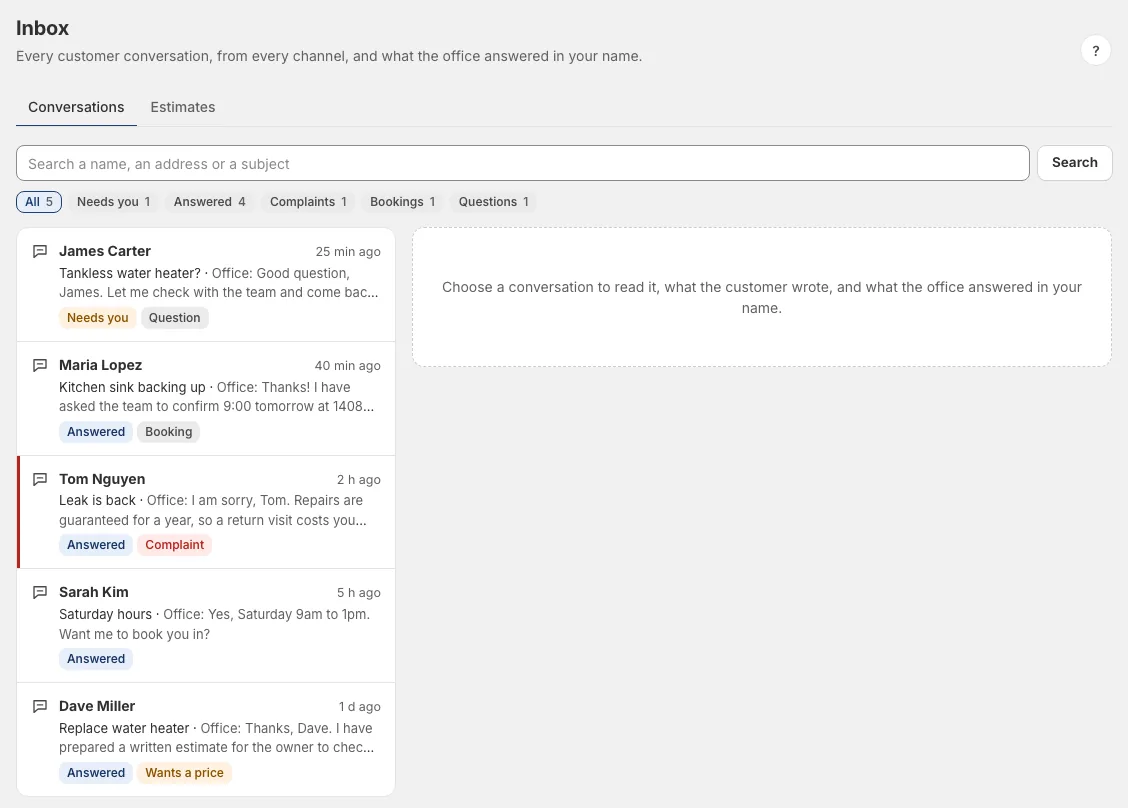
How Neaion does it.
Your office reads your website and help pages once and turns them into written answers you check and switch on. It answers email from up to five mailboxes, your website's chat and your Telegram bot from those answers, in the customer's language, and says it was written with AI. A question your answers do not cover comes to you, and one tap turns your reply into an answer for next time. Crash alerts and customers' bug reports are gathered into one counted list of issues. See how your office answers customers and Neaion for software startups.
Asked before you start.
When should a startup hire its first support person?
When the questions that need a person, not the routine ones, take more of your week than you can give. Until then, written answers and one inbox go a long way.
Can an AI answer my customers safely?
If it answers only from your own written answers, says it is AI, and sends everything else to you. An AI that answers from general knowledge will one day invent something.
What should never be answered automatically?
Refunds, angry customers, anything about a contract and anything new. Those should reach a person the same day.
How fast should support answer?
As fast as you can for the first reply. A question answered within the hour turns more trials into customers than a perfect answer tomorrow.
Read next
Set up your office in an afternoon.
Free to set up, no card needed. It reads your website, asks what it could not find, and nothing goes live until you have checked it.